
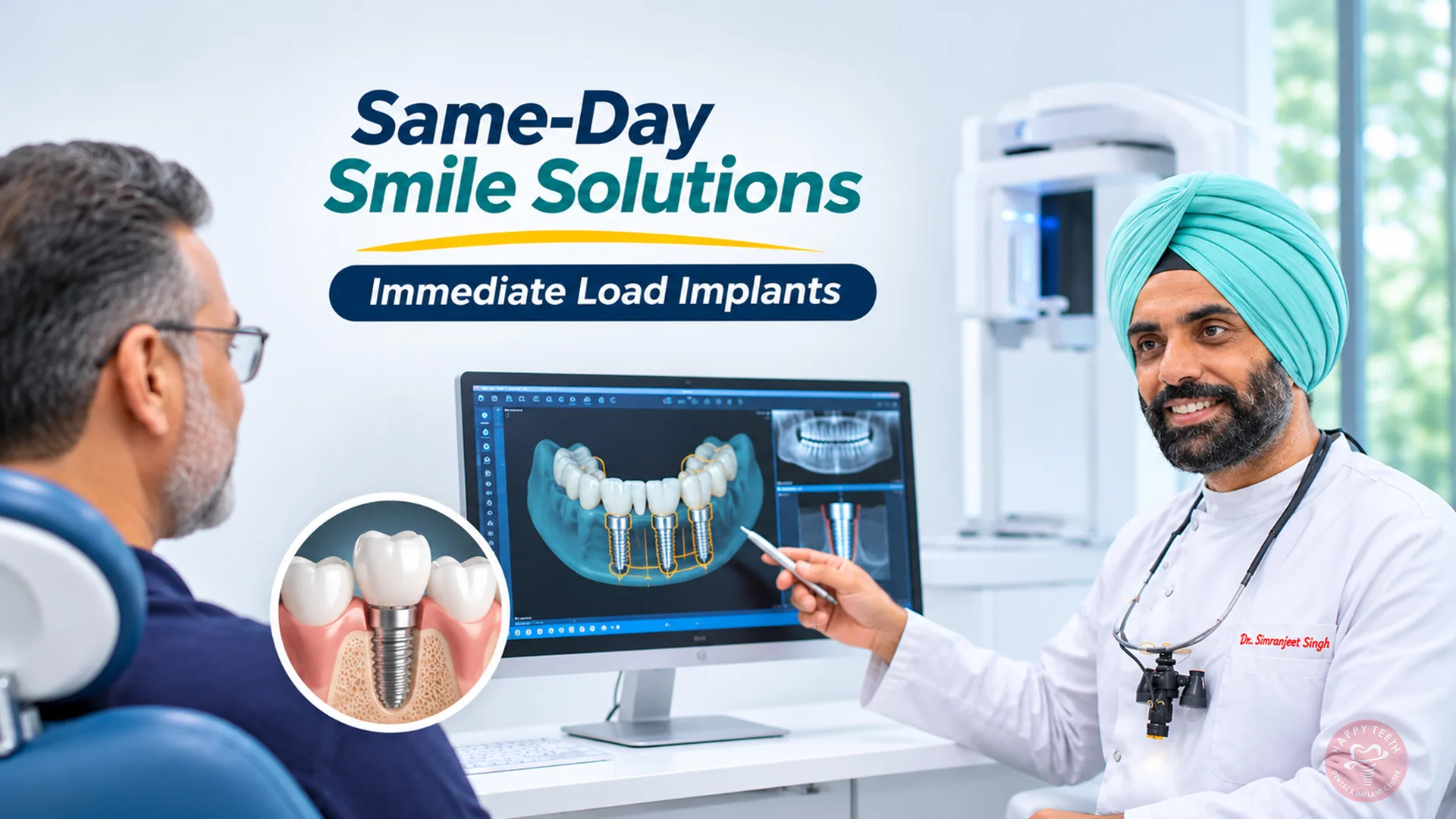
Same-Day Smile Solutions: The Reality of Immediate Load Implants
Choosing Immediate Load Implants in India has revolutionized modern restorative dentistry for international travelers, Non-Resident Indians (NRIs), and busy professionals who cannot afford to put their lives on hold. For decades, conventional implant protocols required patients to undergo surgery and then wait three to six months without a fixed tooth while the titanium post fused with the jawbone. For overseas patients visiting Punjab for a brief two or three-week vacation, that prolonged waiting window often meant traveling with removable plastic flippers or postponing necessary care altogether.
Today, advanced surgical engineering and digital diagnostics have turned immediate smile restoration into a predictable clinical reality. Rather than waiting months with an empty gap, qualified candidates can receive their dental implant post and walk out of the clinic with a secure, aesthetic provisional tooth on the exact same day. However, achieving immediate success requires far more than speed; it demands uncompromising biological planning, high-torque primary stability, and advanced diagnostic imaging.
At Happy Teeth Dental & Implant Centre, located near Punjab Mata Nagar Chowk, we provide evidence-based restorative care designed to fit the condensed schedules of visiting travelers. Led by Dr. Simranjeet Singh, an experienced Dentist in Ludhiana, our practice combines 3D CBCT bone diagnostics with premium global implant systems like Zimmer Biomet. This comprehensive clinical guide explores the biomechanics of immediate loading, explains how 3D planning guarantees surgical safety, and clarifies exactly who qualifies for this game-changing procedure.
- What Are Immediate Load Implants? Moving Beyond Outdated Timelines
To understand why immediate loading is such a significant advancement, it helps to understand how dental implants heal. When a titanium implant is anchored into the jawbone, the surrounding bone cells gradually grow directly onto the textured surface of the metal—a biological phenomenon discovered in the 1950s known as osseointegration.
In traditional delayed protocols, surgeons avoided placing any physical pressure on the implant post during the initial 12 to 24 weeks of healing. Clinicians feared that even microscopic chewing movements would disturb the delicate bone-healing front, leading to fibrous scar tissue encapsulation rather than rigid bone integration. As a result, patients had to wear removable dentures or live with gaps between their teeth until final restorations could be attached.
Modern Immediate Load Implants in India challenge that outdated timeline through refined biomechanical engineering:
- Immediate Provisional Placement: In an immediate load protocol (often called “same-day teeth” or “immediate provisionalization”), a customized aesthetic temporary crown or bridge is attached directly to the implant post within 24 to 48 hours of surgery.
- Immediate Soft-Tissue Sculpting: Placing an immediate temporary crown guides the surrounding gum tissue as it heals, preserving the natural interdental papilla (the delicate pink triangles of gum between teeth) and preventing gum collapse.
- Immediate Psychological Relief: Patients never have to endure the social embarrassment or speech impediments associated with missing front teeth or loose, clicking temporary acrylic dentures during their holiday.
- Permanent Loading Later: While the immediate temporary tooth restores aesthetics, speech, and light function immediately, the final permanent restoration—such as multi-layered Zirconia—is permanently bonded after full biological osseointegration is complete.
To explore how advanced implant dentistry restores lifelong chewing strength, explore our specialized Dental Implants protocols.
- The Biomechanics of Primary Stability: How Brands Like Zimmer Biomet Excel
The clinical success of an immediate load implant depends on a single mechanical metric: achieving exceptional primary stability at the exact moment of surgical placement.
Primary stability refers to the purely mechanical friction between the threads of the titanium implant post and the surrounding native jawbone. If an implant post can be locked into dense bone with sufficient mechanical torque, microscopic shifting during normal speaking and swallowing is completely prevented, allowing biological osseointegration (secondary stability) to proceed undisturbed underneath.
The Role of Insertion Torque
In oral surgery, insertion torque is measured in Newton-centimeters (Ncm). For an implant to qualify safely for immediate loading:
- The Minimum Torque Threshold: The surgical handpiece must register an insertion torque of at least 35 to 45 Ncm during placement.
- Preventing Micro-Motion: Research confirms that if micro-motion at the bone-implant interface remains below 100 to 150 microns, bone cells fuse to titanium without interference.
- High-Torque Engineering: Premium implant brands achieve this high level of stability through specialized physical geometries rather than excessive bone compression.
Engineering Excellence: Zimmer Biomet and Premium Platforms
At Happy Teeth Dental, we partner with world-renowned implant manufacturers such as Zimmer Biomet, Straumann, and Nobel Biocare. These premier systems incorporate patented mechanical features engineered specifically for immediate stability:
- Aggressive Tapered Core Designs: The tapered body of a Zimmer Biomet Tapered Screw-Vent mimics the conical shape of a natural tooth root. As the post is threaded into the osteotomy site, it compresses the trabecular bone laterally, creating a firm mechanical lock even in softer bone types.
- Variable Pitch Thread Geometry: Triple-lead micro-threads at the crestal neck distribute biting stresses evenly across the cortical bone plate, preventing bone resorption at the gumline.
- Advanced Surface Topography: Micro-textured surfaces, such as Zimmer’s MTX micro-textured titanium or proprietary Trabecular Metal, dramatically increase the physical bone-to-implant contact (BIC) area, accelerating the transition from mechanical primary grip to biological secondary integration.
- Friction-Fit Internal Connections: Deep internal hex connections create a rigid cold-weld seal between the post and the abutment, eliminating microscopic hinge movements that could loosen retaining screws over time.
- 3D CBCT Bone Diagnostics: Precision Planning by Dr. Simranjeet Singh
Achieving high-torque stability safely requires complete diagnostic visibility of the patient’s unique anatomical structures. Placing an immediate implant blindly or relying exclusively on flat, two-dimensional X-rays carries significant biological risks.
At our modern facility near the Indoor Stadium, every immediate implant procedure is guided by a comprehensive digital imaging workflow:
Evaluating Bone Quality and Volume in Three Dimensions
Using advanced Full Mouth X-Rays (OPG) alongside 3D Cone Beam Computed Tomography (CBCT), Dr. Simranjeet Singh analyzes cross-sectional slices of your upper and lower jaws with sub-millimeter precision:
- Hounsfield Unit (HU) Bone Density Mapping: The software measures bone mineralization levels, categorizing your bone from dense cortical bone (D1/D2, ideal for immediate loading) to softer, porous bone (D4, requiring modified surgical drilling protocols).
- Cortical Bone Engagement: To achieve high stability, Dr. Singh identifies anatomical anchor points, such as engaging the dense inferior border of the mandible or the nasal cortical floor in the upper jaw.
- Vital Nerve and Sinus Protection: High-resolution scans map the exact three-dimensional path of the Inferior Alveolar Nerve (IAN) in the lower jaw and the boundaries of the maxillary sinus cavities in the upper jaw, ensuring a safe distance is maintained throughout the procedure.
The Digital Surgical Workflow
- Instant Digital Diagnostics: Low-dose Digital X-Rays provide rapid diagnostic checks before, during, and after surgical placement.
- Touchless Optical Impressions: Using an advanced Intraoral Scanner, an ergonomic wand captures a complete 3D digital model of your dental arches in under two minutes, eliminating gooey, uncomfortable impression putties.
- AI-Guided Surgical Planning: With Digital Treatment Planning (AI Tools), the implant angle, depth, and rotational position are synchronized with the planned aesthetic crown before surgery begins, ensuring optimal aesthetic and functional outcomes.
- Candidacy and Expectation Management: Who Qualifies for Immediate Loading?
While same-day smile restorations sound ideal for every traveling patient, clinical ethics and biological safety demand honest patient selection. Immediate loading is not a universal solution for every clinical situation; it is an advanced technique that requires specific biological conditions.
A transparent clinical consultation distinguishes between patients who are ideal candidates and those who benefit more from traditional staged healing:
Ideal Candidates for Immediate Load Implants
- Adequate Native Bone Volume: The patient possesses sufficient vertical height and horizontal width of healthy bone to completely encase the implant post without extensive grafting.
- Dense Bone Quality (Type II or Type III Bone): Firm trabecular and cortical bone that allows the surgeon to achieve an insertion torque of 35 Ncm or higher comfortably.
- Controlled Occlusal Forces: Patients without severe, untreated nighttime bruxism (teeth grinding) or heavy clenching habits that could overload a healing implant.
- Good Systemic Health: Non-smokers or light smokers with well-managed systemic health, free from uncontrolled diabetes or active immunosuppressive therapies that impair bone healing.
- Single Front Teeth or Complete Arches: Immediate loading is highly predictable for cosmetically visible front teeth (where biting forces can be adjusted out of occlusion) or full-arch All-on-4/All-on-6 restorations (where multiple implants are splinted together rigidly).
When Traditional Staged Healing is the Safer Choice
- Severe Bone Atrophy Requiring Major Grafting: If a site requires extensive block bone grafting, vertical ridge augmentation, or complex sinus floor lifting, the grafted bone must mature for several months before it can support heavy chewing forces.
- Active, Untreated Periodontal Disease: If generalized gum inflammation is present, the oral cavity must first be stabilized through thorough Routine Dental Care to eliminate harmful bacteria that could cause peri-implant infection.
- Inability to Achieve 35 Ncm Torque: If native bone density is unexpectedly soft (Type IV bone) and the post does not reach the required mechanical grip during surgery, Dr. Simranjeet Singh will prioritize patient safety, placing a protective healing cap and allowing standard healing rather than risking premature implant failure.
The Golden Rule: “Immediate Smile, Not Immediate Chewing”
Managing patient expectations is vital for long-term clinical success. An immediate load provisional crown is engineered primarily for social aesthetics, speech, and gum contouring—not for biting into hard foods.
During the initial 8 to 12 weeks of healing:
- The immediate crown is adjusted to be completely “out of occlusion,” meaning it does not make direct physical contact with the opposing teeth when you bite down.
- Patients must adhere to a soft-food diet, avoiding crusty breads, nuts, hard meats, and raw vegetables on the surgical side.
- Following biological osseointegration, custom permanent Crowns & Bridges milled from high-strength Zirconia are placed, restoring full chewing power for a lifetime.
- Side-by-Side Comparison: Traditional Delayed Loading vs. Immediate Load Protocols
Reviewing how these two surgical protocols compare across clinical factors highlights why immediate loading is so valuable for international patients:
- Initial Restorative Timeline: Traditional delayed protocols require 3 to 6 months of healing before any crown is attached. Immediate load protocols place a fixed, aesthetic provisional tooth within 24 to 48 hours of surgery.
- Temporary Tooth Aesthetic Solution: Traditional methods rely on removable acrylic dentures (flippers), clear plastic retainers, or leaving an open space along the gumline. Immediate load protocols utilize a fixed, non-removable screw-retained provisional crown that looks and feels like a natural tooth.
- Soft-Tissue Gum Architecture: Traditional protocols often result in flattened gum contours that require secondary laser uncovering surgery later. Immediate load protocols preserve the natural gum scallops and interdental papilla from Day 1.
- Surgical Appointments Required: Traditional protocols involve two distinct surgical stages: post placement followed by secondary uncovery. Immediate load protocols combine post placement, abutment connection, and temporary restoration into a single appointment.
- Required Primary Insertion Torque: Traditional protocols require only 15 to 20 Ncm of insertion torque. Immediate load protocols strictly require 35 to 45+ Ncm of primary stability.
- Suitability for Short Travel Windows: Traditional protocols require two separate international trips separated by several months. Immediate load protocols allow overseas patients to complete the surgical and aesthetic phases in a single 7-day visit.
- The 7-Day Travel Blueprint for Visiting International Patients
For international patients traveling to Punjab from Canada, the UK, the US, or Australia, coordinating care within a tight itinerary is essential. At Happy Teeth Dental, we have organized the immediate load pathway into a predictable, streamlined sequence:
- Day 1: Arrival & 3D Diagnostic Architecture: You arrive at our clinic near Punjab Mata Nagar Chowk for high-resolution 3D CBCT scanning, digital intraoral optical mapping, and virtual surgical planning. Dr. Simranjeet Singh reviews your bone density, discusses shade preferences, and finalizes your surgical roadmap.
- Day 2: Gentle Surgical Placement & Immediate Provisionalization: Under profound local numbing, the failing tooth is gently extracted (if present) and the premium titanium post is placed. Primary stability is verified with torque sensors. An optical digital scan is taken of the post position, and our laboratory fabricates your custom provisional crown.
- Day 3: Provisional Delivery & Smile Reveal: Your customized temporary tooth is securely attached to the implant post and adjusted out of direct biting contact. You walk out of the clinic with a complete, confident smile.
- Days 4 to 6: Leisure and Vacation Time: Enjoy uninterrupted family celebrations, dining, shopping, and sightseeing in Ludhiana while the surgical site undergoes initial soft-tissue healing.
- Day 7: Clinical Review & Departure: A brief 20-minute follow-up ensures comfortable healing and verifies gum margins. You receive your official International Dental Implant Passport containing original manufacturer batch barcodes, ready to return home with total confidence.
- Comprehensive Care for the Entire Dental Arch
An immediate load implant often serves as the centerpiece of a wider smile restoration. At Happy Teeth Dental, complementary dental treatments are seamlessly integrated into your visit:
- Endodontic Root Preservation: When adjacent teeth suffer from deep decay or structural fractures, gentle Endodontics (Root Canal Therapy) saves the natural biological roots before restorative crowns are placed.
- Aesthetic Smile Harmony: If neighboring teeth display tea stains or fluorosis, combining implant placement with cosmetic veneers through Cosmetic Dentistry creates a uniform, radiant smile line.
- Bite Stabilization: For patients with underlying crowding or bite collapse, coordinated planning through Orthodontics ensures long-term functional stability.
- Authoritative Clinical Consensus and Global Implant Guidelines
The safety and efficacy of immediate load protocols are backed by decades of clinical trials and international public health directives.
Global Surgical Authority Reference: The American Association of Oral and Maxillofacial Surgeons (AAOMS) confirms that immediate implant loading is a highly predictable clinical modality when supported by comprehensive 3D radiographic diagnostics, rigorous patient selection, and the achievement of high initial insertion torque (>35 Ncm).
Local India Authority Reference: The Indian Dental Association (IDA) provides comprehensive clinical practice standards for implantology across India, emphasizing the mandatory use of 3D CBCT imaging, certified biocompatible titanium platforms, and documented material passports to protect patient health in cross-border healthcare.
Global Clinical Practice Consensus: Practice parameters established by the American Dental Association (ADA) highlight that immediate provisionalization preserves peri-implant soft tissues and supports superior aesthetic outcomes, provided occlusal loads are carefully controlled during the initial healing window.
Global Health Guidance: The World Health Organization (WHO) underscores that modern medical device traceability, certified sterilization, and digital diagnostic protocols are essential for maintaining safety and clinical efficacy in cross-border restorative care.
- Frequently Asked Questions (FAQ) About Immediate Load Implants in India
What is the difference between an immediate implant and an immediate load implant?
An “immediate implant” refers to placing a titanium post into the jawbone socket immediately after a tooth extraction in the same appointment. An “immediate load implant” goes one step further by attaching a functional or aesthetic temporary crown onto that post within 24 to 48 hours of placement.
Is the surgical procedure for immediate load implants painful?
No. Advanced, pH-buffered local anesthesia completely numbs the surgical site, bone, and surrounding gums. Patients remain awake, alert, and comfortable, feeling only gentle pressure and vibrations during the procedure. Post-operative discomfort is typically mild and managed easily with standard over-the-counter pain relievers for two to three days.
Can I eat normally with an immediate load temporary tooth?
You can eat comfortably, but you must follow a soft-food diet during the initial 8 to 12-week healing phase. The temporary crown is intentionally adjusted out of direct biting contact to prevent heavy forces from disturbing the healing bone. Patients should avoid biting directly into hard, crunchy, or chewy foods (like raw apples, tough meats, or crusty bread) on the implant site.
What happens if my bone density is not strong enough for immediate loading?
Patient safety always takes precedence over speed. If Dr. Simranjeet Singh determines during surgery that your bone density does not achieve the required 35 Ncm torque for immediate loading, a protective healing abutment will be placed instead. The implant will be allowed to heal undisturbed for standard osseointegration, ensuring the long-term survival of your restoration.
Will my dentist in Canada, the UK, or the US be able to service my implant later?
Yes. At Happy Teeth Dental, we exclusively place globally recognized, FDA-approved systems such as Zimmer Biomet, Straumann, and Nobel Biocare. Every patient receives an official International Dental Implant Passport documenting the exact platform dimensions, connection geometries, and sterile manufacturer batch numbers, ensuring worldwide compatibility and maintenance.
- Why Happy Teeth Dental is Ludhiana’s Trusted Implant Destination
Undergoing advanced restorative surgery requires complete trust in your clinical team’s skill, technology, and transparency. At Happy Teeth Dental & Implant Centre, we treat every implant procedure as a precise blend of medical science and artistic reconstruction.
Centrally located near Punjab Mata Nagar Chowk in SBS Nagar, our modern clinic near the Indoor Stadium provides a calm, welcoming, and hospital-clean environment. Dr. Simranjeet Singh takes the time to listen to your personal goals, review your 3D CBCT scans with you on chairside monitors, and provide clear, honest guidance on whether immediate loading is safe for your smile. We eliminate surgical guesswork, delivering strong, beautiful teeth that restore your confidence and fit your travel schedule.
Restore Your Smile in a Single Visit: Book Your Diagnostic Scan Today
You no longer have to spend months waiting with an empty gap in your smile or wearing uncomfortable removable dentures while traveling. Thanks to advanced biomechanical engineering, 3D digital planning, and premium platforms like Zimmer Biomet, Immediate Load Implants in India offer a safe, comfortable, and predictable path to a restored smile.
At Happy Teeth Dental & Implant Centre, we are ready to help you reclaim your smile without compromising your holiday itinerary.
Take the first step toward your new smile today. Book an Appointment Online with Dr. Simranjeet Singh near Punjab Mata Nagar Chowk, and discover the life-changing benefits of same-day digital implant solutions!
High-stability biomechanics and 3D digital diagnostics engineered for immediate smile restoration.
- Practice Name: Happy Teeth Dental & Implant Centre
- Chief Dentist & Implantologist: Dr. Simranjeet Singh
- Location Profile: Punjab Mata Nagar Chowk, Near Indoor Stadium, SBS Nagar, Ludhiana, PB 141002
- Direct Clinical Helpline: (0) 87290 – 00980